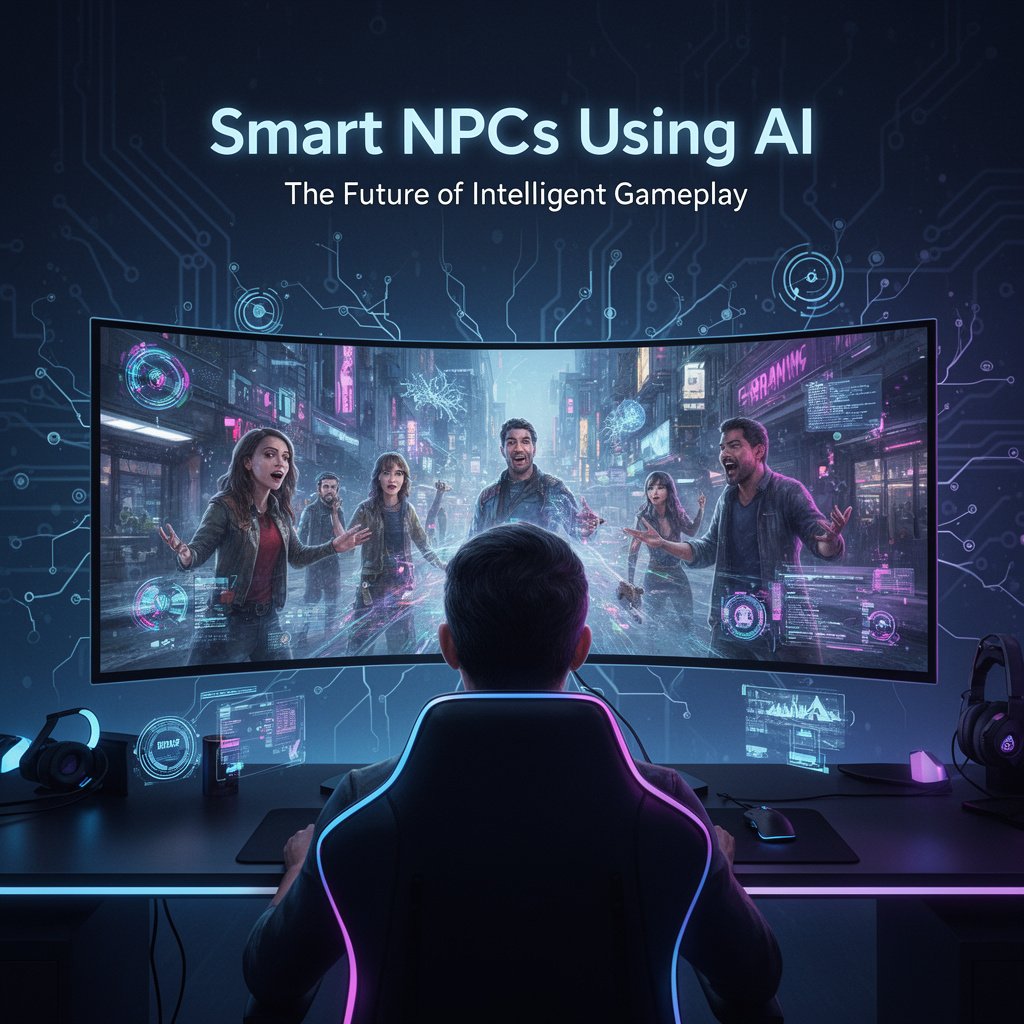
I still remember the first time an NPC genuinely surprised me. It wasn’t a scripted moment or a pre-programmed response. The character actually remembered something I’d done three hours earlier and brought it up in conversation. That small interaction completely changed how I thought about what games could become.
For years, non-playable characters followed predictable patterns. They stood in designated spots, repeated the same dialogue, and reacted to players through rigid decision trees. But that era is fading fast. Smart NPCs powered by artificial intelligence are fundamentally altering how we experience virtual worlds.
What Makes an NPC “Smart”?
Traditional NPCs operate on scripts. When a player performs action A, the NPC responds with reaction B. It’s functional but shallow. You can almost see the puppet strings after a few hours of gameplay.
Smart NPCs work differently. They process context, learn from interactions, and generate responses that weren’t explicitly programmed. Instead of pulling from a database of pre-written lines, these characters can formulate unique dialogue based on the situation at hand.
I spoke with several indie developers last year who’ve been experimenting with these systems. One described it as giving NPCs “common sense reasoning.” They understand cause and effect, remember past events, and adjust their behavior accordingly. When you help a shopkeeper in the morning, they might offer you a discount that evening—not because someone coded that specific scenario, but because the AI recognized your positive relationship.
The Technology Driving This Revolution

Several technological advances have made smart NPCs feasible. Large language models enable NPCs to engage in natural conversations rather than cycling through predetermined options. Machine learning algorithms allow characters to observe player behavior and adapt over time.
Pathfinding has also evolved dramatically. Modern AI doesn’t just calculate the shortest route between two points. Smart NPCs consider factors like danger, stealth, and even emotional states when navigating environments. A frightened character might avoid open areas. An aggressive one might choose confrontational paths.
The real breakthrough came when developers started combining these systems. An NPC that can hold genuine conversations, remember past interactions, navigate intelligently, and display emotional responses creates something that feels remarkably alive.
Real Examples Worth Examining
“Vaudeville” from Unnatural Studios, released in 2023, showcased some impressive NPC intelligence. Characters in the game maintained persistent memories across sessions. They formed opinions about the player based on accumulated experiences rather than single choices.
Ubisoft has been investing heavily in this space. Their recent patents describe systems where NPCs dynamically generate quests based on player preferences and world states. Rather than triggering the same mission for every player, NPCs assess individual playing styles and offer tailored content.
Smaller games have pushed boundaries too. “Dwellings,” a survival game I covered extensively, features NPCs that genuinely learn. Leave food unattended, and nearby characters will remember that location. They’ll return later when hungry. It creates emergent storytelling that surprises even the developers.
The Benefits Are Substantial
Smart NPCs solve persistent problems in game design. Replay value increases dramatically when characters behave unpredictably. Every playthrough becomes genuinely unique rather than superficially different.
Immersion deepens considerably. Nothing breaks the spell of a fantasy world faster than an NPC repeating the same line for the hundredth time. When characters respond contextually and remember your history together, the world feels inhabited rather than populated with props.
Development efficiency potentially improves too. Writing branching dialogue for every possible scenario consumes enormous resources. AI systems can generate appropriate responses dynamically, reducing the scripting burden while increasing content variety.
Challenges and Limitations
Let’s be honest about the difficulties here. Smart NPCs require significant processing power. Running sophisticated AI for dozens of characters simultaneously strains even powerful systems. Cloud-based solutions help but introduce latency and require constant internet connections.
Quality control becomes trickier. When NPCs generate responses dynamically, ensuring they remain appropriate and consistent with the game’s tone presents genuine challenges. Early implementations occasionally produced bizarre or contradictory statements.
There’s also the uncanny valley problem applied to behavior rather than appearance. NPCs that are almost human-like but occasionally reveal their artificial nature can feel more unsettling than obviously scripted characters.
Ethical Considerations Matter
This technology raises important questions. Players can form emotional connections with smart NPCs. When those characters remember you, engage in meaningful conversations, and adapt to your personality, the relationship feels real on some level.
Developers carry responsibility for how these relationships are designed. Manipulative patterns could exploit those connections. Characters engineered to encourage spending or extended play time represent potential ethical concerns the industry needs to address proactively.
Data privacy also enters the conversation. Smart NPCs that learn from player behavior necessarily collect and process information about how people play. Transparency about what data is gathered and how it’s used matters.
Looking Forward
The trajectory seems clear. Within the next few years, we’ll likely see smart NPCs become standard rather than exceptional. Processing power continues increasing while AI techniques grow more efficient.
The real question is whether games will use this capability meaningfully. Technology enables impressive possibilities, but implementation determines value. Smart NPCs could revolutionize storytelling, creating personalized narratives that respond to individual players. Or they could become novelties that wear thin after initial amazement fades.
Based on what I’ve observed from development studios, the ambition exists to make this technology genuinely transformative. The talent and resources are being directed toward creating characters that enhance gaming experiences in lasting ways.
Final Thoughts
Smart NPCs represent more than technical achievement. They’re changing the fundamental relationship between players and game worlds. Characters that remember, learn, and genuinely respond create experiences that feel personal in ways previously impossible.
We’re still early in this evolution. The smart NPCs of 2024 will seem primitive compared to what’s coming. But the foundation is solid, and the direction is promising. For those of us who grew up with NPCs who never changed, this new era feels genuinely exciting.
Frequently Asked Questions
What exactly is a smart NPC?
A smart NPC uses artificial intelligence to generate dynamic responses, remember player interactions, and adapt behavior based on context rather than following pre-written scripts.
Which games currently feature smart NPCs?
Notable examples include “Vaudeville,” certain Ubisoft titles, and various indie games like “Dwellings” that emphasize emergent NPC behavior.
Do smart NPCs require internet connections?
Not necessarily, though some implementations use cloud processing. Many games run NPC intelligence locally on the player’s hardware.
Will smart NPCs replace traditional game writing?
Unlikely. Smart NPCs complement rather than replace authored content. Writers still create character foundations, world lore, and narrative frameworks.
Are there privacy concerns with smart NPCs?
Yes. NPCs that learn from behavior collect player data. Responsible developers should be transparent about data practices.
When will smart NPCs become standard in games?
Industry experts suggest mainstream adoption within three to five years as processing becomes more affordable and development tools mature.